Tehran Locked Down: Millions Mass in Streets as Iran Unveils Casket of Slain Supreme Leader Ayatollah Ali Khamenei in Grand Farewell

The Grand Mosalla Unveiling
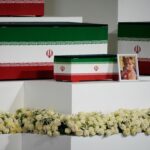
The state funeral rituals commenced with immense emotional outpouring as authorities presented the casket of Ayatollah Ali Khamenei to the public. The former leader’s coffin, topped with his iconic black turban signifying his descent from the Prophet Muhammad, was placed under tight glass security at Tehran’s Grand Mosalla.
Directly beneath his casket sat smaller, secondary coffins containing his family members—including his eldest daughter, son-in-law, and 14-month-old granddaughter—who perished in the same February 28 airstrike that opened the 2026 Iran War. Mourners packed the halls under a severe summer heatwave, tossing personal scarves toward attendants to be brushed against the caskets for traditional blessings.
Airspace Closed and Capital Blockaded
To accommodate an expected turnout of 10 to 15 million citizens, the Iranian government has suspended daily administrative life and entirely reshuffled domestic logistics:
- Total Airspace Shutdown: The Civil Aviation Organization announced that Tehran’s airspace will be completely sealed to all commercial traffic during peak ceremonial windows, particularly on Monday during the mass street parade.
- Armed Cordon Lines: Police units armed with assault rifles have erected concrete blast barriers across central thoroughfares. Inside the venue, men and women are segregated through multi-tiered metal detectors and strict body searches.
- The Stand on Hormuz: Paramilitary Revolutionary Guard commanders have used the funeral as a public platform to demonstrate regional strength, stating that their absolute control over the Strait of Hormuz remains a primary lever in ongoing diplomatic talks.
Political Tensions and Successor Absence
The massive, unified crowd of black-clad mourners contrasted sharply with a highly tense political landscape. Conspicuously absent from the primary public viewing was Iran’s newly appointed Supreme Leader, Ayatollah Mojtaba Khamenei. Reports indicate Mojtaba, who was wounded in the initial strike that killed his father and lost his own wife in the blast, skipped the public display due to lingering security anxieties regarding potential targeted operations.
The funeral also carries deep diplomatic overtones. In South Dakota, U.S. President Donald Trump addressed a cheering crowd at Mount Rushmore, stating that Washington paused active hostilities for a week out of respect for the funeral. In Tehran, however, deep anti-Western sentiment lingered, with prominent groups of mourners holding large banners calling for direct retaliation against U.S. leaders.
Conclusion
Ayatollah Ali Khamenei’s grand farewell serves as the most profound moment of collective national mourning in Iran since the 1989 burial of Ayatollah Ruhollah Khomeini. By coordinating an extensive six-day progression through Tehran, Qom, and the holy Shiite sanctuaries of Iraq, the Iranian state is attempting to leverage this immense public display to consolidate internal stability under its new leadership. How the regime translates this moment of public grief into diplomatic power will dictate the terms of the fragile peace talks set to resume immediately after the final burial on July 9.