
Monsoon Fury in Northeast: Over 22,000 Hit by First Wave of Floods in Assam and Arunachal Pradesh as Infrastructure Collapses

The Destruction of Key Infrastructure
The relentless downpour has caused massive structural failures throughout the region. In Assam’s hardest-hit Dhemaji district, the surge of the Simen River caused a vital section of a railway bridge built in 1965 to partially collapse, forcing Northeast Frontier Railway officials to indefinitely suspend train services between Archipathar and Simen Chapari stations. Concurrently, a 300-meter-long iron bridge over the raging Kemi River was completely washed away, fully isolating the Kemi-Purana Jelom region from Jonai Sadar.
Meanwhile, in downstream areas, a colossal landslide blocked the natural flow of the Siji River in Arunachal Pradesh’s Lower Siang district. This sudden natural damming has prompted emergency flash flood warnings for downstream Assamese villages as water volumes swell dangerously.
Arunachal Pradesh Cut Off by Landslides
The situation remains equally grim in neighbouring Arunachal Pradesh, where intense cloudbursts dumping up to 72.8 mm of rain within a single three-hour window have triggered fatal landslides.
- Western Zone Isolated: Six major western districts—including Keyi Panyor, Lower Subansiri, Upper Subansiri, Kra Daadi, Kurung Kumey, and Kamle—remain entirely cut off due to highway blocks.
- Casualties Mount: The monsoon death toll in Arunachal Pradesh has risen to three, with multiple personnel still reported missing at the NEEPCO project colony in Yazali Circle following the collapse of an under-construction retaining wall.
- Air Rescue Operations: The Indian Air Force (IAF) was deployed into the Lower Dibang Valley district on Monday, successfully deploying a helicopter to airlift four civilians stranded on a rapidly shrinking island in the Sisiri River.
Rivers Swell Past Danger Marks
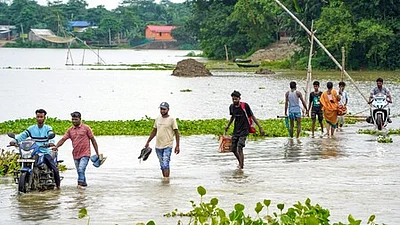
The Assam State Disaster Management Authority (ASDMA) reported that the Brahmaputra River and its primary northern tributaries are rising at alarming rates. Currently, the Disang River in Sivasagar district has crossed its danger level mark at Nanglamuraghat, threatening to spill over into local agricultural belts.
The sudden rush of water was compounded last week when the Panyor Lower Hydroelectric Project area opened a spillway gate to release excess water following extreme inflows in its upper catchments. Local administrations have established temporary relief camps and distribution centres for the thousands forced to flee using makeshift bamboo rafts.
Conclusion
The first major monsoon wave of 2026 has exposed the intense vulnerability of India’s northeastern frontier to seasonal climate emergencies. While central and state disaster response forces (NDRF and SDRF) are actively executing search, rescue, and relief operations on the ground, the destruction of arterial bridges and highways poses an immediate bottleneck to rehabilitation efforts. With the India Meteorological Department predicting continued downpours over the next 48 hours, the absolute priority remains the safe evacuation of low-lying riverside communities.