
ISRO Successfully Tests Revised PSLV Third Stage, Strengthens Rocket Reliability
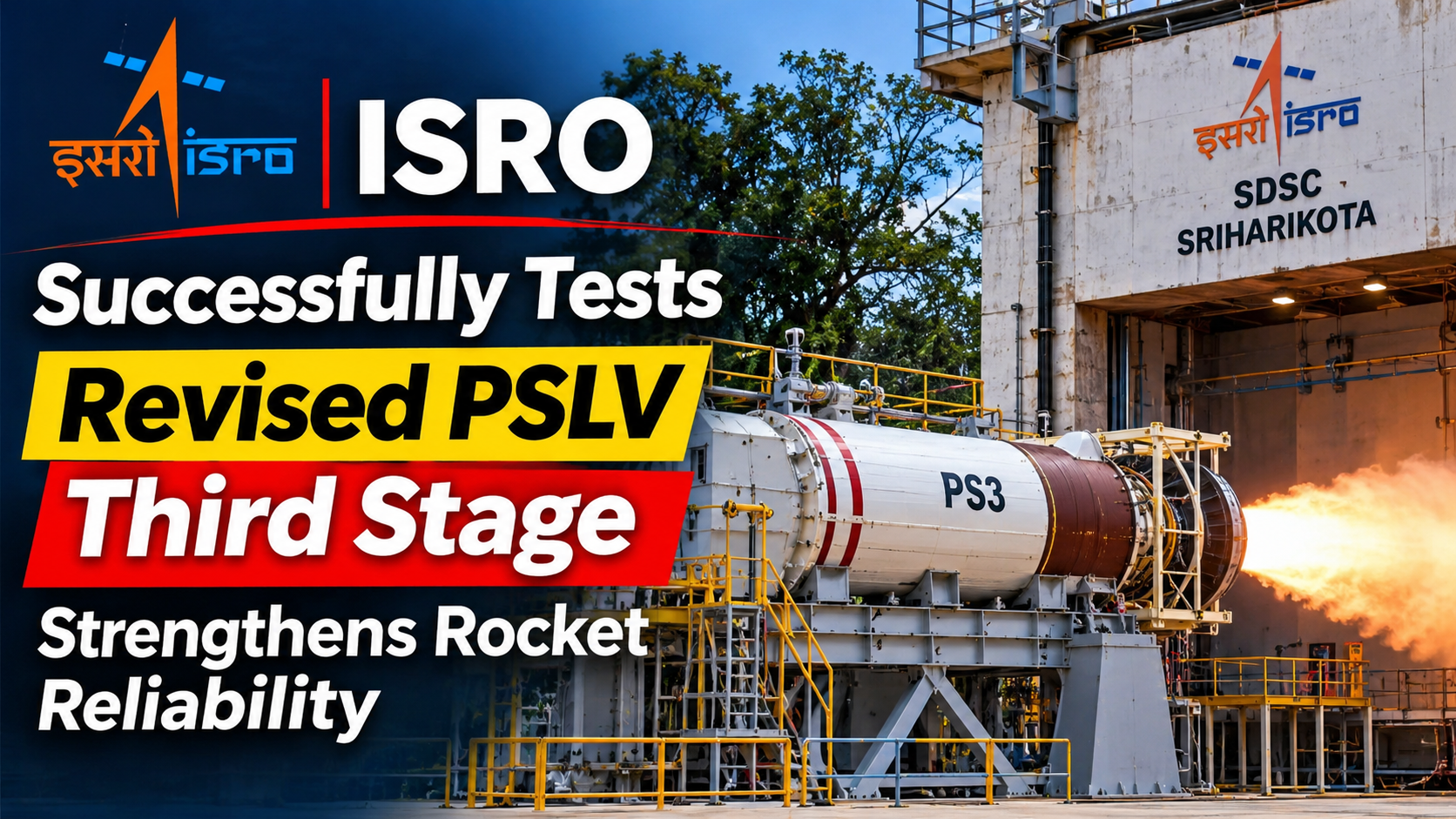
The Indian Space Research Organisation (ISRO) has successfully conducted a ground static test of the revised third stage (PS3) of its Polar Satellite Launch Vehicle (PSLV) at the Static Test Facility of the Satish Dhawan Space Centre (SDSC), Sriharikota, Andhra Pradesh, on November 12, 2026.
The successful test marks an important step in ISRO’s efforts to improve PSLV reliability following anomalies observed during the PSLV-C61/EOS-09 and PSLV-C62/EOS-N1 missions.
According to ISRO, the revised PS3 solid motor stage incorporates improvements to its nozzle configuration, mechanical interfaces, sealing systems, raw material acceptance procedures and quality checks.
The latest test follows earlier static tests of a modified HPS3 motor conducted on October 6 and November 19, 2025, as documented in ISRO’s Annual Report 2025–26.
ISRO Successfully Completes Revised PSLV Third-Stage Test
The ground static test was conducted at the Static Test Facility at SDSC, Sriharikota, on November 12, 2026.
ISRO said the PS3 configuration was comprehensively reviewed after anomalies during the third-stage operation of two previous PSLV missions. The review covered design margins, raw material acceptance criteria, assembly procedures and quality-control practices.
The revised configuration includes improvements to the nozzle, strengthened mechanical interfaces, additional redundancy in sealing systems and updated Non-Destructive Testing (NDT) procedures.
ISRO has stated that the test data will undergo detailed analysis and review, following which further tests are planned.
The November 12 test was a ground-based static motor test, not an actual rocket launch.
Earlier HPS3 Static Tests Conducted in 2025
ISRO’s Annual Report 2025–26 records two successful static tests of the modified HPS3 motor on October 6 and November 19, 2025, at SDSC, Sriharikota.
These tests followed recommendations from a national-level committee constituted to investigate the PSLV-C61 third-stage anomaly.
According to the annual report, the overall performance of the modified motor and its subsystems during these tests was as expected and closer to nominal performance.
The two tests formed part of the development and validation work on the modified third-stage motor. The November 12, 2026 test represents a subsequent milestone involving the revised PS3 configuration.
Why Did ISRO Modify the PSLV Third Stage?
The modifications followed anomalies observed during two PSLV missions.
PSLV-C61/EOS-09 Mission – May 18, 2025
The PSLV-C61 mission lifted off on May 18, 2025, carrying the EOS-09 Earth observation satellite. ISRO’s Annual Report states that the vehicle performed normally until the second stage, but an anomaly occurred during the functioning of the third-stage solid motor. The mission could not be accomplished.
A national-level committee was constituted to investigate the issue and recommend corrective measures.
PSLV-C62/EOS-N1 Mission – January 2026
The PSLV-C62/EOS-N1 mission also encountered an anomaly during the end of the PS3 stage, according to ISRO’s mission update dated January 8, 2026.
Following the two incidents, ISRO reviewed the third-stage configuration and introduced modifications to strengthen the motor and improve its manufacturing and testing procedures.
Major Improvements Made to the PSLV PS3 Stage
ISRO has highlighted several improvements in the revised third-stage configuration.
1. Improved Nozzle Configuration
Changes have been made to the nozzle configuration to improve design margins.
2. Strengthened Mechanical Interfaces
The mechanical interfaces have been strengthened to improve structural integrity.
3. Additional Sealing System Redundancy
Redundancy has been introduced into the sealing systems to improve protection at critical interfaces.
4. Updated Raw Material Acceptance Procedures
ISRO has updated procedures for accepting raw materials used in the manufacturing of the solid motor stage.
5. Revised Assembly and Quality Checks
Assembly procedures and quality checks have been updated to strengthen manufacturing and integration processes.
6. Improved Non-Destructive Testing
Updated NDT procedures have been implemented during different phases of integration and transportation. These checks help identify potential defects without damaging the components.
Understanding the Four Stages of the PSLV Rocket
The Polar Satellite Launch Vehicle is a four-stage launch vehicle that uses alternating solid and liquid propulsion systems.
| PSLV Stage | Stage Name | Propulsion Type |
|---|---|---|
| First Stage | PS1 | Solid |
| Second Stage | PS2 | Liquid |
| Third Stage | PS3 / HPS3 | Solid |
| Fourth Stage | PS4 | Liquid |
The third stage, known as PS3, uses a high-energy solid rocket motor. It plays an important role in the vehicle’s flight and propulsion sequence.
The alternating solid and liquid propulsion arrangement enables PSLV to carry out its multi-stage launch sequence and deliver satellites into their intended orbits.
Does a Successful Ground Test Guarantee PSLV Flight Success?
No. A successful ground static test does not guarantee that a rocket will perform successfully during an actual flight.
A static test allows engineers to evaluate the performance of a motor while it is secured at a test facility. It provides important information about motor operation and the performance of its subsystems under test conditions.
However, an actual launch involves additional factors, including vehicle integration, stage separation, flight control, environmental conditions and the performance of all systems during flight.
Therefore, the November 12 test should be viewed as an important validation milestone, not as final proof of flight reliability.
ISRO has itself stated that detailed analysis of the test data is required and further tests are planned.
What Happens Next After the Successful Test?
ISRO will analyse the data collected during the November 12 ground static test.
Further tests are planned based on the detailed analysis and review. The results will help engineers evaluate the revised configuration and determine the next steps in the validation process.
The upcoming tests and future flight performance will provide further evidence of how effectively the modifications address the earlier anomalies.
Why Is This Development Important for India’s Space Programme?
PSLV has played a major role in India’s satellite launch programme and has supported several national and international space missions.
Strengthening the reliability of its third stage is important for maintaining confidence in the launch vehicle and supporting future satellite deployment missions.
The latest test also highlights ISRO’s efforts to apply engineering reviews, design improvements and quality-control measures following technical anomalies.
Frequently Asked Questions (FAQs)
1. When did ISRO test the revised PSLV third stage?
ISRO successfully conducted the ground static test of the revised PS3 stage on November 12, 2026.
2. Where was the PSLV third-stage test conducted?
The test took place at the Static Test Facility of the Satish Dhawan Space Centre in Sriharikota, Andhra Pradesh.
3. When were the earlier modified HPS3 motor tests conducted?
According to ISRO’s Annual Report 2025–26, the two earlier static tests were conducted on October 6 and November 19, 2025.
4. Why did ISRO modify the PSLV third stage?
The modifications followed anomalies during the third-stage operation of the PSLV-C61/EOS-09 and PSLV-C62/EOS-N1 missions.
5. What type of propulsion does the PSLV third stage use?
The PSLV third stage uses a solid rocket motor, known as PS3 or HPS3.
6. Does a successful static test guarantee a successful rocket launch?
No. A ground static test evaluates motor performance under test conditions. Actual flight success depends on the performance of the complete launch vehicle and its systems during flight.
7. Will ISRO conduct further tests of the revised PS3 stage?
Yes. ISRO has said that further tests are planned after detailed analysis and review of the November 12 test data.
#ISRO #PSLV #ISRONews #PSLVThirdStage #HPS3 #SpaceNews #IndianSpaceProgramme #Sriharikota #SpaceTechnology #RocketTesting #PSLVC61 #PSLVC62 #IndiaInSpace