
RBI Introduces New Money Transfer Norms: Check ₹50,000 NEFT Limit, ₹5,000 Transaction Cap and Other Rules
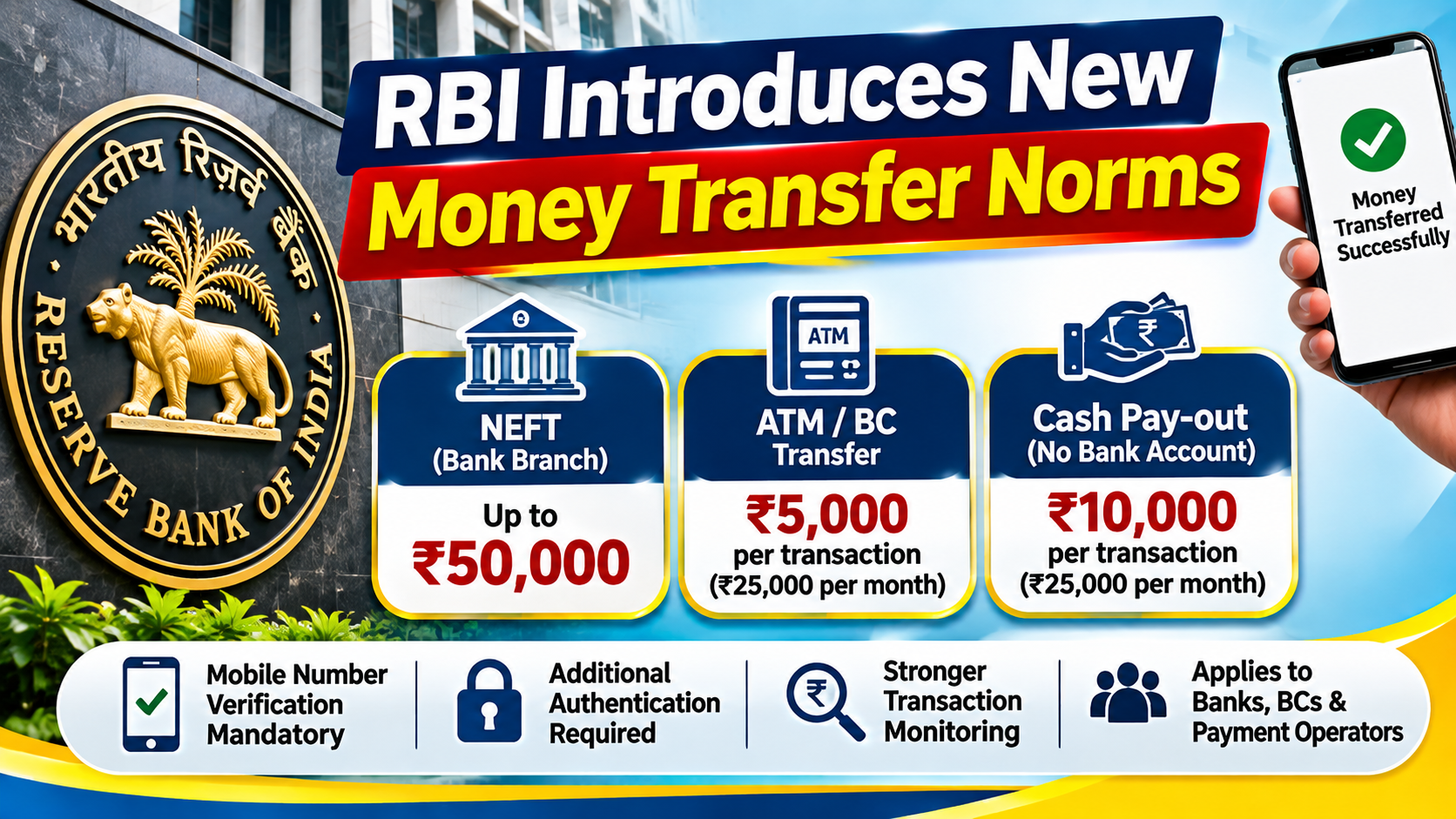
The Reserve Bank of India (RBI) has introduced a consolidated framework for domestic money transfers, bringing existing instructions on cash-based remittances under a single set of directions. The new rules, issued on November 11, 2026, clarify transaction limits, customer verification requirements and safeguards for money transfers through banks and authorised payment service providers.
Under the new RBI Domestic Money Transfer Directions, 2026, customers can transfer up to ₹50,000 in cash through NEFT at a bank branch. Transfers through Business Correspondents (BCs), ATMs and other permitted channels are subject to a limit of ₹5,000 per transaction and ₹25,000 per month per remitter.
The directions have come into effect immediately and apply to scheduled commercial banks, regional rural banks, cooperative banks and authorised payment system operators, as applicable.
RBI New Money Transfer Rules 2026: What Has Changed?
The RBI has consolidated its earlier domestic money transfer instructions into a single regulatory framework. The move is aimed at improving transparency, customer verification and monitoring of cash-based remittances.
The framework covers two major types of services: cash pay-in and cash pay-out.
1. Cash Transfer Through Bank Branches
Customers visiting a bank branch can deposit cash of up to ₹50,000 for transfer to a beneficiary’s bank account through the National Electronic Funds Transfer (NEFT) system.
This facility is particularly useful for people who need to send money but may not have access to digital banking facilities.
2. Money Transfer Through Business Correspondents and ATMs
Customers can also transfer cash to a beneficiary’s bank account through authorised Business Correspondents, ATMs and other permitted channels.
The limits are:
- Maximum ₹5,000 per transaction.
- Monthly limit of ₹25,000 per remitter.
Banks may provide these services through authorised channels subject to the RBI’s prescribed conditions.
3. Cash Withdrawal for Beneficiaries Without Bank Accounts
The RBI has also specified limits for cash pay-out services, where money is transferred from a customer’s bank account and collected in cash by a beneficiary who does not have a bank account.
The limits are:
- Maximum ₹10,000 per transaction.
- Monthly ceiling of ₹25,000 per beneficiary.
The remitting bank must also maintain the beneficiary’s name and address.
RBI Money Transfer Limits: Complete Details
Here is a breakdown of the transaction limits under the RBI Domestic Money Transfer Directions, 2026.
| Transfer Type | Transaction Limit | Monthly Limit |
|---|---|---|
| Cash deposit at bank branch through NEFT | ₹50,000 | As specified by applicable rules |
| Cash transfer through BCs and ATMs | ₹5,000 | ₹25,000 per remitter |
| Cash pay-out to beneficiary without bank account | ₹10,000 | ₹25,000 per beneficiary |
These limits apply to the specified domestic money transfer services. They should not be confused with general UPI, IMPS or online banking transaction limits.
Mobile Number Verification and Additional Authentication Made Mandatory
The RBI has specified customer verification requirements for cash pay-in services.
Banks and Business Correspondents must register remitters using a verified mobile number and a self-certified Officially Valid Document (OVD), as prescribed under the RBI’s applicable Know Your Customer Directions, 2025.
Every transaction must also be validated through an Additional Factor of Authentication (AFA).
This additional verification is intended to improve transaction security and reduce the possibility of unauthorised money transfers.
RBI Strengthens Monitoring of Suspicious Transactions
The new directions require banks and non-bank payment operators to strengthen monitoring systems for domestic money transfers.
Important safeguards include:
- Velocity checks to identify unusual transaction activity.
- Alerts to customers regarding credits received through these facilities.
- Immediate investigation of unusual increases in credits to individual or groups of accounts.
- Reporting suspicious transactions to the appropriate authorities.
- Including remitter details in IMPS and NEFT transaction messages.
- Adding an identifier to distinguish cash-based remittances from other transfers.
The RBI also expects transfers under this framework to be completed on a real-time or near-real-time basis.
Will RBI’s New Rules Affect UPI and Online Money Transfers?
The new directions specifically deal with Domestic Money Transfer services, particularly cash-based remittances through bank branches, Business Correspondents and ATMs.
They should not be interpreted as a blanket change to everyday UPI payments or regular digital bank transfers.
Card-to-card transfers have also been excluded from the scope of these directions and will continue to be governed by the rules applicable to their respective payment instruments.
Customers should check with their banks or authorised service providers for the rules applicable to their specific transfer method.
Why Has RBI Introduced the Consolidated Money Transfer Framework?
Domestic Money Transfer services are particularly important for migrant workers and people who may not have easy access to digital banking or formal banking facilities.
The framework helps people transfer money through authorised banking channels while maintaining transaction records and security checks.
By consolidating the earlier instructions, the RBI aims to create a clearer regulatory framework for banks and payment service providers.
The new directions also subsume and repeal two earlier circulars:
- October 5, 2011: Domestic Money Transfer – Relaxations.
- July 24, 2024: Domestic Money Transfer – Review of Framework.
How Can Customers Raise Complaints About Money Transfers?
The RBI directions provide for grievance-redressal arrangements by banks and non-bank service providers.
Customer complaints relating to services covered by the directions fall within the scope of the Reserve Bank–Integrated Ombudsman Scheme, 2026, as amended.
Customers should first contact their bank or payment service provider and follow its complaint-resolution process.
Frequently Asked Questions About RBI New Money Transfer Rules 2026
1. What are the new RBI money transfer rules in 2026?
The RBI has issued consolidated Domestic Money Transfer Directions, 2026, covering cash pay-in and cash pay-out limits, customer verification, additional authentication and transaction monitoring.
2. What is the maximum cash transfer through NEFT at a bank branch?
A walk-in customer can transfer up to ₹50,000 in cash to a beneficiary’s bank account through NEFT at a bank branch.
3. What is the monthly limit for money transfers through ATMs and Business Correspondents?
The limit is ₹5,000 per transaction, with a monthly ceiling of ₹25,000 per remitter.
4. What is the cash pay-out limit under the new RBI rules?
Cash pay-out is limited to ₹10,000 per transaction, subject to a monthly ceiling of ₹25,000 per beneficiary.
5. Is mobile number verification mandatory?
Yes. Remitters using cash pay-in services must be registered using a verified mobile number and a self-certified officially valid document.
6. Is additional authentication required for every transaction?
Yes. Every transaction under the specified cash pay-in service must be validated through an Additional Factor of Authentication.
7. Do the new RBI rules apply to all UPI payments?
No. These directions specifically cover Domestic Money Transfer services and should not be treated as a blanket restriction on regular UPI payments.
8. When did the new RBI money transfer directions come into effect?
The RBI issued the directions on November 11, 2026, and they became effective immediately.
The RBI’s consolidated Domestic Money Transfer Directions, 2026, provide a clearer framework for cash-based remittances in India. With defined transaction limits, stronger customer authentication and improved monitoring requirements, the new framework aims to make domestic money transfer services more secure and transparent.
#RBI #RBINewRules #MoneyTransfer #BankingNews #RBIGuidelines #NEFT #DigitalBanking #IndianBanking #FinanceNews #RBI2026 #MoneyTransferRules #CashTransfer #BankingUpdates #FinancialNews #LatestNews