
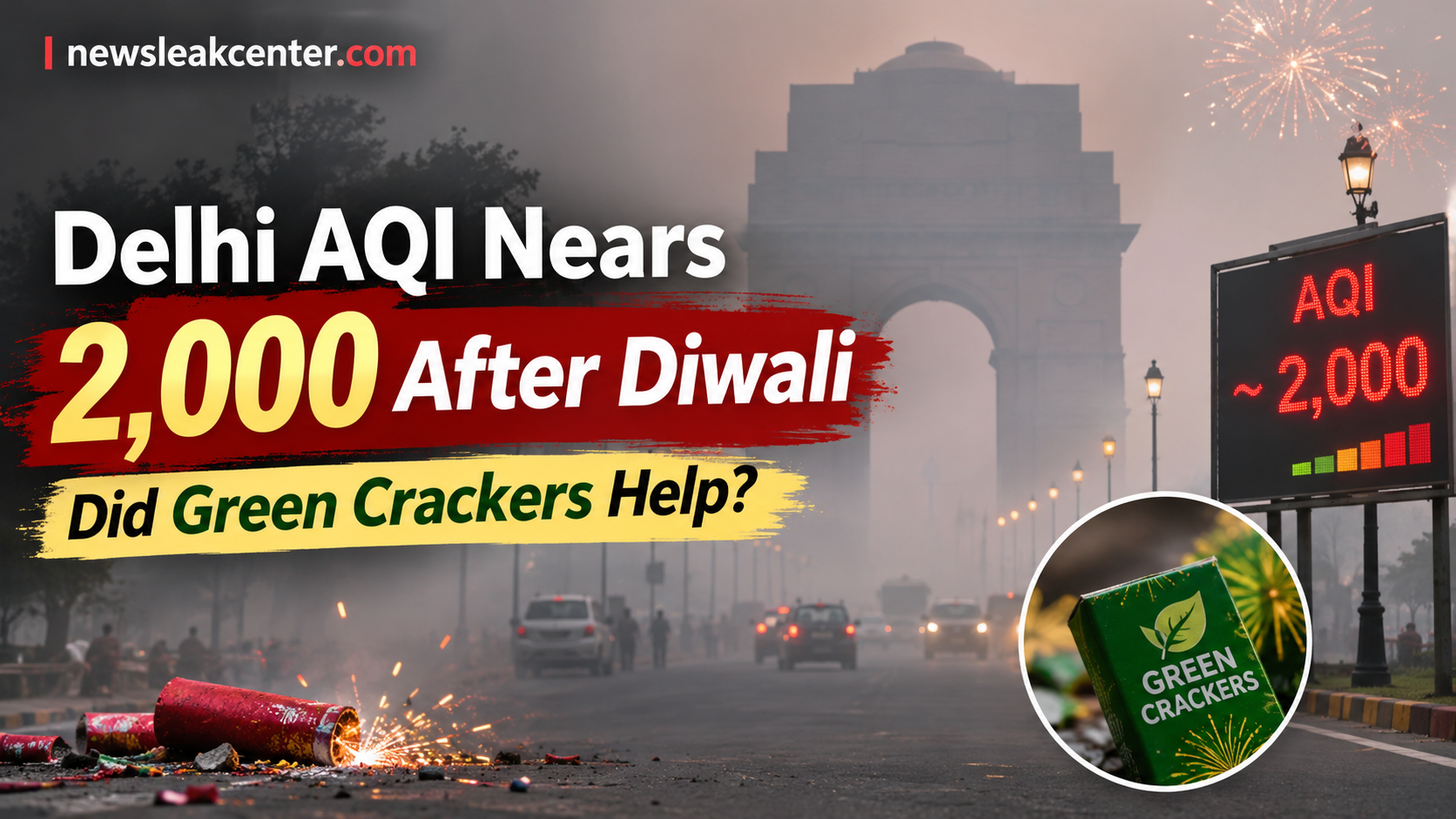
Delhi AQI Nears 2,000 After Diwali: Did Green Crackers Help Reduce Air Pollution?
Byline: Sagufta Rani
Category: Environment / Delhi News
Delhi’s air pollution crisis intensified after Diwali 2026, with thick smog covering several parts of the national capital and air quality deteriorating sharply following firecracker celebrations. While some air-quality platforms reported readings exceeding 1,000 and approaching 2,000, the official figures released by India’s Central Pollution Control Board (CPCB) remained below 500 under its National Air Quality Index (AQI) system.
The situation has renewed an important question: Did green crackers make any difference, or did Diwali celebrations once again worsen Delhi’s air pollution?
Delhi AQI After Diwali 2026: What Happened?
Delhi’s air quality deteriorated sharply after Diwali celebrations on November 8, 2026, as firecracker smoke added to pollution from vehicles, construction dust and waste burning.
According to CPCB data, Delhi’s average AQI reached 376 on November 8, falling under the ‘Very Poor’ category. Meanwhile, AQI.in reportedly recorded a peak reading of 1,331 at 1:31 am on November 9, with some alternative platforms showing readings close to 2,000.
However, these figures are not directly comparable, as CPCB’s official AQI scale ranges from 0 to 500. The high readings highlight the severity of Delhi’s post-Diwali pollution crisis, particularly the rise in PM2.5 levels.
Did Green Crackers Make Any Difference?
Green crackers are designed to reduce harmful emissions compared with conventional firecrackers, but they are not completely pollution-free. Their environmental impact depends on the quantity used and compliance with certification standards.
During Diwali 2026, authorities permitted certified green crackers during specified hours. However, reports indicated that fireworks continued beyond the permitted timings in several areas.
Although green crackers may reduce certain emissions, excessive use can still contribute to air pollution. Therefore, green crackers alone cannot solve Delhi’s pollution crisis.
Firecrackers and PM2.5: What Does the Data Show?
One of the most concerning findings emerged from an assessment by the Indian Institute of Tropical Meteorology (IITM), Pune.
According to a report published by The Indian Express on November 10, IITM’s assessment estimated that firecrackers accounted for 71.1% of Delhi’s PM2.5 pollution during the period from 1 am to 9 am on November 9. The estimated share was 43.4% during the same hours on the night before Diwali and 5.6% during the corresponding period on November 7.
The findings suggest that firecracker emissions became a dominant contributor to fine particulate pollution during the hours immediately following the celebrations.
PM2.5 refers to airborne particles measuring 2.5 micrometres or less in diameter. These particles are particularly concerning because they can penetrate deep into the lungs and may enter the bloodstream.
However, the IITM figures represent estimated source contributions for specific time windows. They should not be interpreted as a full-day pollution breakdown or as proof that all the measured pollution came from conventional crackers rather than green crackers.
Why Did Some Platforms Show AQI Near 2,000?
The difference between official AQI figures and online readings caused confusion among residents because different platforms use different calculation methods.
CPCB’s official AQI scale ranges from 0 to 500, while other platforms may use different scales and monitoring sources. During Diwali night, some monitoring stations also recorded missing PM readings because pollution levels exceeded their measurement range.
CPCB clarified on November 11 that its particulate-matter analysers measure concentrations up to 1,000 micrograms per cubic metre. When levels exceed this limit, readings may appear as data gaps instead of showing higher values.
This has raised concerns about whether existing monitoring systems can accurately capture sudden pollution spikes. Readers should always check the source and calculation method before comparing AQI figures from different platforms.
Why Does Delhi’s Pollution Become Worse After Diwali?
Firecrackers are an important short-term source of pollution during Diwali, but Delhi’s air-quality crisis has several underlying causes.
1. Firecracker emissions
Fireworks release fine particles, gases and chemical compounds. When many crackers are burst within a short period, pollutant concentrations can rise rapidly.
2. Vehicle emissions
Cars, buses, trucks and other vehicles release pollutants that contribute to Delhi’s existing pollution burden. These emissions continue even after the festival ends.
3. Construction and road dust
Construction sites, uncovered materials and dust from roads add particulate matter to the atmosphere. Poor dust management can make the situation worse.
4. Stubble burning in neighbouring states
Smoke from agricultural residue burning can travel towards Delhi-NCR under suitable wind conditions. Its contribution varies according to the intensity of burning and prevailing weather.
5. Unfavourable weather conditions
During the winter season, weak winds, low temperatures and a shallow atmospheric mixing layer can prevent pollutants from dispersing efficiently. This allows pollution from different sources to accumulate near the ground.
The combination of these factors makes Delhi’s post-Diwali pollution problem more complicated than a single-day firecracker issue.
How Does Severe Air Pollution Affect Health?
High concentrations of air pollution can affect people of all ages, particularly children, older adults, pregnant women, outdoor workers and people with existing respiratory or cardiovascular conditions.
Short-term exposure to elevated particulate pollution may cause:
- Coughing, throat irritation and difficulty breathing.
- Burning or watery eyes.
- Worsening asthma and other respiratory conditions.
- Increased strain on the heart and lungs.
- Reduced tolerance for outdoor physical activity.
PM2.5 is especially concerning because its small size allows it to travel deep into the respiratory system.
People experiencing significant breathing difficulty, chest pain or other serious symptoms should seek prompt medical attention.
How Can Delhi Residents Protect Themselves?
As pollution levels rise after Diwali, residents can take practical steps to reduce exposure.
- Check current air-quality updates from official monitoring sources such as CPCB.
- Reduce strenuous outdoor exercise when pollution levels are very high.
- Keep windows closed during periods of heavy smoke, while maintaining appropriate indoor ventilation when outdoor air improves.
- Consider a properly sized indoor air purifier with a HEPA filter, if available.
- Use a well-fitting N95 or equivalent respirator when outdoor exposure is unavoidable; ordinary cloth masks offer limited protection against fine particles.
- Follow health advice for children, older adults and people with asthma or heart and lung conditions.
- Avoid burning waste and other materials, which add to local pollution.
These measures can help reduce exposure, but they cannot eliminate the risks posed by severe outdoor air pollution.
What Needs to Be Done to Reduce Delhi’s Air Pollution?
The post-Diwali pollution episode highlights the need for a long-term strategy rather than relying only on temporary restrictions. Authorities need effective enforcement of firecracker rules, transparent air-quality monitoring, improved pollution-control measures and public awareness about the health effects of polluted air.
Monitoring stations must also be capable of accurately documenting extreme pollution episodes, with clear explanations when readings fall outside an instrument’s measurement range. At the same time, reducing vehicle emissions, controlling road and construction dust, preventing waste burning and coordinating action with neighbouring states can help address the sources that contribute to pollution throughout the year.
Residents also have a role to play by following applicable firecracker restrictions, avoiding unnecessary burning and supporting cleaner celebrations.
Green Crackers Alone Cannot Solve Delhi’s Pollution Crisis
Delhi’s post-Diwali air-quality crisis in November 2026 shows that the city continues to face serious challenges in controlling pollution during the winter season. Although green crackers are intended to reduce certain emissions, they are not emission-free and cannot guarantee clean air when fireworks are used extensively. The reported contribution of firecrackers to PM2.5 pollution during the hours after Diwali underlines the need for responsible celebrations and stronger enforcement.
At the same time, Delhi’s pollution cannot be blamed on firecrackers alone. Vehicle emissions, road dust, construction activities, waste burning, regional smoke and unfavourable weather conditions also contribute to the problem. Ultimately, green crackers may be part of a pollution-reduction strategy, but cleaner air will require fewer emissions, better enforcement, reliable monitoring and sustained action throughout the year.
Stay updated with the latest Delhi pollution news, environmental developments and breaking news on NewsLeakCenter.com.
#DelhiAQI #DelhiPollution #DelhiAirPollution #DelhiAQIAfterDiwali #GreenCrackers #DiwaliPollution #AirPollution #PM25 #DelhiNews #DelhiNCR #AirQualityIndex #FirecrackerPollution #EnvironmentNews #PollutionCrisis #IndiaNews #NewsUpdate #BreakingNews #NewsLeakCenter