
🇮🇳 DRDO Joins ‘Elite Club’: High-Speed Ejection System Test Success at 800 km/h
Indigenous Pilot Escape System Validated on Tejas Forebody, Marking Major Milestone Towards Self-Reliance in Aerospace Safety
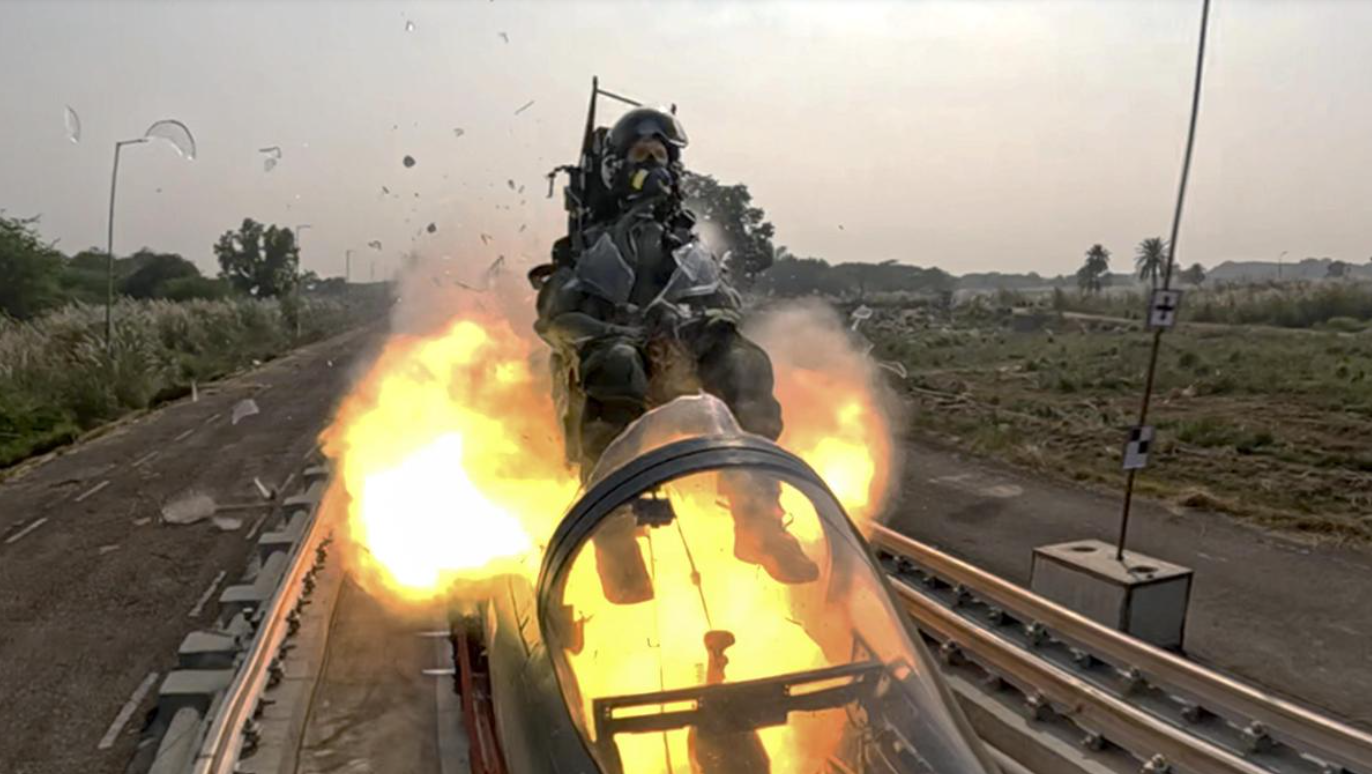
The Defence Research and Development Organisation (DRDO) has achieved a major technological milestone by successfully conducting a high-speed, dynamic test of an indigenous fighter aircraft escape system. The trial, which involved propelling the system at a precisely controlled velocity of 800 km/h, confirms India’s capability to design, develop, and test advanced crew safety mechanisms for its frontline fighter fleet. This success instantly places India in an “elite club of nations” capable of conducting such complex dynamic evaluations, reinforcing the national commitment to Atmanirbhar Bharat (self-reliant India) in critical aerospace technology.
The Complex Dynamic Test: LCA Tejas at 800 km/h
The DRDO Ejection System Test was executed at the state-of-the-art Rail Track Rocket Sled (RTRS) facility of the Terminal Ballistics Research Laboratory (TBRL) in Chandigarh. Unlike static “Zero-Zero” tests, the rocket-sled trial simulates the extreme aerodynamic loads and stresses a pilot faces during a real high-speed in-flight emergency.
For the test, the forebody of the Light Combat Aircraft (LCA) Tejas was mounted on a dual-sled system and accelerated using multiple solid-propellant rocket motors. The trial successfully validated the entire aircrew survival sequence, which includes:
- Canopy Severance: The mechanism designed to shatter the cockpit canopy in milliseconds.
- Ejection Sequencing: The precise ignition of the rocket motors to propel the seat.
- Aircrew Recovery: The safe separation and recovery process of the pilot (simulated using an instrumented Anthropomorphic Test Dummy).
The dummy recorded crucial data on loads and accelerations, ensuring the system protects pilots from dangerous G-forces.
A Significant Leap for Indigenous Fighters
This successful DRDO Ejection System Test is a pivotal step for India’s indigenous fighter projects. While the current Tejas Mk-1 uses a foreign ejection seat, the validated design paves the way for integrating a domestically developed system into upcoming platforms, including the LCA Tejas Mk-2 and the Advanced Medium Combat Aircraft (AMCA).
Defence Minister Rajnath Singh congratulated DRDO, the Indian Air Force (IAF), the Aeronautical Development Agency (ADA), and Hindustan Aeronautics Limited (HAL), calling the achievement a “significant milestone” that guarantees safety for Indian pilots and enhances the technological base of the domestic aerospace industry.